
There are a multitude of body language signals that dogs use to communicate. They don’t rely on verbal communication as much as we do; instead, they rely on body language signals. This is their main way of communicating. In this post, we will explore dog body language – debunking myths that commonly mislead dog owners. Understanding dog body language myths and facts is important for handling your interactions with other dogs, strangers, and the outside world. Great trainers understand what dogs are really saying.
Understanding Dog Body Language Myths
There are a few classic mistakes people make with dog body language, slipping up thinking the dog is happy when it isn’t. Let’s get started.
The tail wag
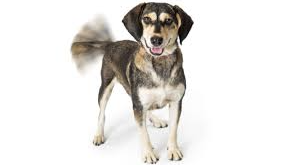
This misconception is one of the many myths surrounding dog body language, a really common dog body language mistake people make.
Not all tail wags are happy! In fact, I would argue that most tail wagging is not happy. Dogs wag their tail for many reasons, including arousal, nervousness, anxiety, anger leading to aggression, appeasement and excitement. Dogs that are intent on causing harm, aggressive dogs, dogs that want to bite, they may wag their tails. A nervous dog will probably have a nervous tail wag where just the tip moves and the rest of the body stays quite stiff.
A truly happy dog will have a whole bum wiggle, where the rear of the dog moves side to side as the whole tail swooshes side to side. Take things in context also, if the dog is about to be fed then it probably is a happy tail wag! If the dog is in the vet room and the tail is low and stiff and the dog has a worried expression then it isn’t a happy tail wag.
Understanding dog body language myths will help you respond appropriately to your dog’s needs.
Probably the most misinterpreted of all is the “he’s friendly” tail wag. Where 2 dogs are greeting each other and the owners see the tails wagging and assume the dog is happy. Not necessarily. If the tail is stiff, rigid, only wagging at the tip, or tucked down close to the body with a tiny wag at the end, or if it is up high and pointy like a pencil with a really fast wag this is not happiness, this is something else.
The high up pointy like a pencil tail is an assertive dog, with a tense wag, it is not saying I am happy, it is saying I am tense, I am wary of you, I am not comfortable, I want to be in control here.
Therefore, dog body language myths and facts should be a priority for all dog lovers.
So always think about context and if the whole bum isn’t wiggling then it probably isn’t a happy wag!
Submission or “rub my belly”
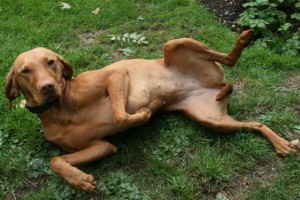
When a dog lies on its side it is not the same as it lying completely on its back, with its whole spine on the ground. When a dog lies on its side it is not completely on its back. This means the dog is offering appeasement signals, I am asking/begging you to stop or move away, I am guarded and I am conflicted, I will show you some of my underbelly but not all of it, I am requesting that you give me space, that you back off, that you stop what you are doing.
People often mistake this for “please rub my belly” no, it isn’t. The dog will have a tense face, tight jaw and a worried expression.
By learning about dog body language myths and reality, you can better assess your dog’s emotional state.
Always remember that dog body language is vital for setting your dog up to succeed, to avoid fights, to keep your dog happy.
A dog that really wants you to rub the belly will be fully on its back, legs splayed, throat exposed, it will have a happy face, may be swooshing its tail and will fully expose all its genitals in true trusting form. This is an invitation to touch the dog. It is not the same as the half-roll where the dog is not fully on its back, like the Viszla in the picture. Look at the mouth, it is clamped shut, the ears are pinned back and the dog has a worried expression.
It’s a really easy one to get wrong and can have serious consequences if you do get it wrong as the nervous roll is definitely NOT an invitation to touch the dog. This is a really important one to understand.
Yawning when not tired
We yawn when we are tired. Dogs do too but not as much as we do and most of their yawning is a communication to say the dog wants some space, the dog is nervous, a bit stressed out with what is going on, it is an appeasement signal to whatever is going on around. The dog is saying I am not really happy, I feel a bit overwhelmed, can you back off, I am stressed, this is all a bit too much for me.
It’s an easy one to recognise because it will most likely be the dog is not tired and it is asking for a break from what is going on.
Useful to know if you are training or doing any cooperative care or anything hands on with the dog, where it might need a little break.
Hackles = aggression
People call them heckles, they are not heckles! They are hackles. Yes, hackles, also known as piloerection can be a sign of aggression, dogs often raise their hackles when they are aggressive, but it can also just mean arousal. When the hairs stand up on end as can happen to us if we experience something shocking or arousing. So it’s not always a bad thing.
Again, as with all body language you have to look at context, what is going in in that moment? This really helps clear up any ambiguity in the situation.
Other dog body language myths
A few more examples of dog body language myths are the smile being mistaken for aggression, the pounce being mistaken for play, and the guilty look which isn’t really guilt, it’s worry and submission in response to how the owner is reacting to the dog. Do you recognise any of these dog body language myths?
Check out my Facebook page for more tips and ideas. www.facebook.com/bemoredog.co.uk
Also check out my other blog on dog anxiety. https://bemoredog.co.uk/blog/dog-anxiety-the-silent-epidemic/